Email Automation for Remote Businesses: How to Build a Sales Engine That Works Across Time Zones
If you run a business in a northern or remote market, you already know the challenge: your customers are spread across vast distances, your team is small, and you can’t be online 24/7 to answer questions or push promotions. That’s exactly why email automation for remote businesses isn’t a nice-to-have — it’s the backbone of a sustainable sales engine.
Done right, email automation lets you nurture leads, recover lost sales, and build customer loyalty while you sleep, hike, or deal with a blizzard. In this guide, we’ll walk through the five email flows every cold-climate brand should have running, plus practical tips for segmentation and timing that actually work in sparse markets.
Why Remote and Northern Businesses Need Email Automation More Than Ever
Urban businesses can rely on foot traffic, same-day delivery, and constant social media buzz to stay top of mind. Northern and remote brands don’t have those luxuries. Your customers may only visit your store — physical or digital — a handful of times per year. That makes every touchpoint count.
Email automation bridges the gap between infrequent visits by:
- Keeping your brand visible between purchase cycles
- Reducing the burden on small teams who can’t manually follow up with every customer
- Personalizing communication at scale, even with a modest subscriber list
- Adapting to seasonal rhythms that define northern buying behavior
According to industry benchmarks, automated email sequences generate up to 320% more revenue per email than non-automated broadcasts. For remote businesses where every customer relationship matters, that’s a number worth paying attention to.
The 5 Email Flows Every Cold-Climate Brand Should Build First
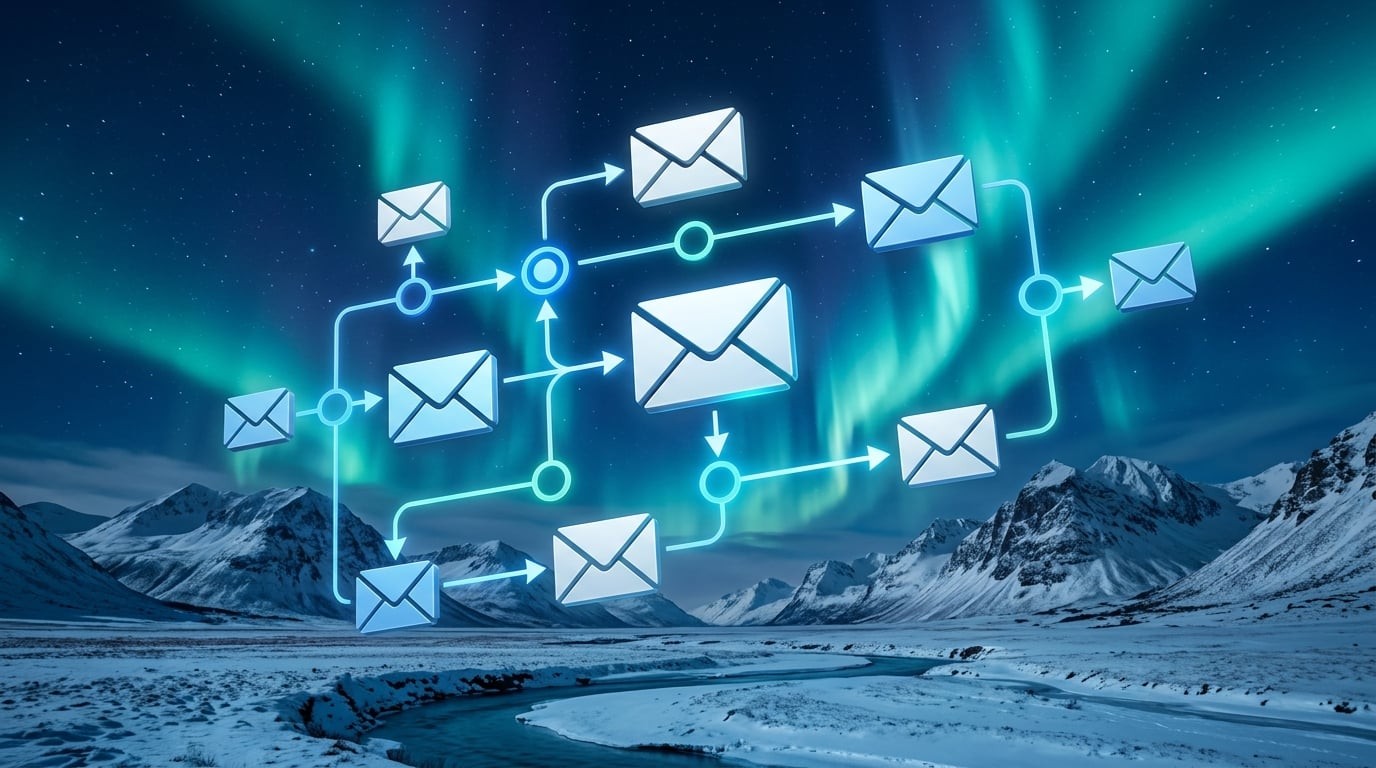
You don’t need a complex tech stack to get started. Focus on these five foundational flows, and you’ll have a sales engine that runs year-round.
1. The Welcome Series (Days 1–7)
Your welcome sequence is the most important automation you’ll ever build. New subscribers are at peak interest — don’t waste it with a single “thanks for signing up” email.
A strong welcome series for northern brands should:
- Email 1 (Immediate): Deliver your lead magnet or welcome offer, introduce your brand story, and set expectations for what subscribers will receive
- Email 2 (Day 2–3): Share your most popular content or product — something that demonstrates your expertise in serving northern or remote customers
- Email 3 (Day 5–7): Make a soft offer or invite them to follow you on social media, with a clear CTA tied to a seasonal or location-specific benefit
2. The Post-Purchase Flow (Days 1–14 After Purchase)
Turning a first-time buyer into a repeat customer is five times cheaper than acquiring a new one. Your post-purchase sequence should:
- Confirm the order and set clear shipping expectations (especially important when delivery timelines are longer in remote areas)
- Follow up with care instructions, usage tips, or complementary product suggestions
- Request a review or photo 7–10 days after estimated delivery
- Send a loyalty incentive (discount, early access, or referral offer) around day 14
3. The Abandoned Cart Recovery Flow
Cart abandonment rates average around 70% across e-commerce. For northern brands where customers may be comparison shopping across limited options, a well-timed recovery sequence can recapture a significant portion of lost revenue.
Send three emails:
– 1 hour after abandonment: Friendly reminder with a direct link back to the cart
– 24 hours later: Address common objections (shipping time, return policy, product questions)
– 72 hours later: Final nudge with a small incentive if appropriate
4. The Seasonal Re-Engagement Flow
Northern markets have distinct seasonal rhythms — freeze-up, breakup, summer tourism peaks, and holiday windows. Build automated flows that activate based on calendar triggers:
- Pre-season: Alert customers to new inventory, seasonal services, or limited-time offers before the season begins
- Mid-season: Share relevant content (guides, tips, local events) that keeps your brand useful, not just promotional
- End-of-season: Clearance offers, next-season previews, or loyalty rewards for repeat buyers
5. The Win-Back Flow (For Inactive Subscribers)
Subscribers who haven’t opened an email in 90–180 days are costing you deliverability. A win-back sequence helps you either re-engage them or clean your list:
- Email 1: “We miss you” message with your best recent content or offer
- Email 2 (1 week later): A direct question — “Still interested?” with a clear re-subscribe or preference update link
- Email 3 (1 week later): Final notice before removal, sometimes with a compelling last offer
How to Segment Customers by Season, Location, and Buying Behavior
Segmentation is what separates a generic email blast from a message that feels personal. For northern and remote businesses, the most valuable segments are:
- Geographic segments: Customers in different regions may have different shipping timelines, seasonal windows, and product needs. Even a rough split (e.g., coastal vs. inland, or by province/territory) can improve relevance.
- Purchase history segments: First-time buyers, repeat buyers, and high-value customers each deserve a different communication cadence and offer type.
- Seasonal engagement segments: Track who opens emails during winter vs. summer. Some customers are seasonal — they buy once a year during a specific window. Automate a targeted sequence that activates just before their typical buying season.
- Lifecycle stage segments: New subscribers, active customers, and lapsed customers all need different messaging. Don’t send a win-back offer to someone who bought last week.
Most email platforms — including Mailchimp, Klaviyo, and ActiveCampaign — make basic segmentation straightforward. Start with two or three segments and expand as your list grows.
Subject Line and Timing Tips for Sparse-Market Audiences
Timing and subject lines matter everywhere, but they matter differently in northern markets.
On timing:
– Test send times around local work patterns. Many northern communities have early-morning routines tied to outdoor work, fishing, or commuting. Early morning (6–8 AM local time) or early evening (6–8 PM) often outperforms midday.
– Avoid sending during major local events — freeze-up, hunting season, or community festivals — when open rates tend to drop.
– For seasonal flows, trigger emails 2–3 weeks before the relevant season begins, not the week of.
On subject lines:
– Reference place and season when relevant: “Getting ready for breakup season?” or “Your winter order is on its way” outperforms generic subject lines.
– Keep subject lines under 50 characters for mobile — many northern customers check email on phones with limited connectivity.
– Use curiosity and specificity over hype: “The 3 products our Yukon customers reorder every spring” beats “HUGE SALE — Don’t Miss Out!”
Start Small, Automate Consistently
You don’t need to build all five flows at once. Start with your welcome series and post-purchase flow — these two alone will have the biggest impact on revenue and customer retention. Once those are running, add the abandoned cart and seasonal flows.
At ArcticMarketer, we cover the full spectrum of digital marketing strategies built for northern and remote businesses. For more on building customer loyalty in sparse markets, check out our guide on The Northern Marketer’s Dashboard: 9 KPIs That Actually Predict Revenue and our breakdown of Mobile Marketing for Low-Connectivity Regions.
Email automation isn’t about replacing the personal touch that makes northern businesses special — it’s about making sure that touch reaches every customer, every time, without burning out your team.
Ready to build your first automated email flow? Start with your welcome series this week — it’s the highest-ROI automation you can launch in under an hour.