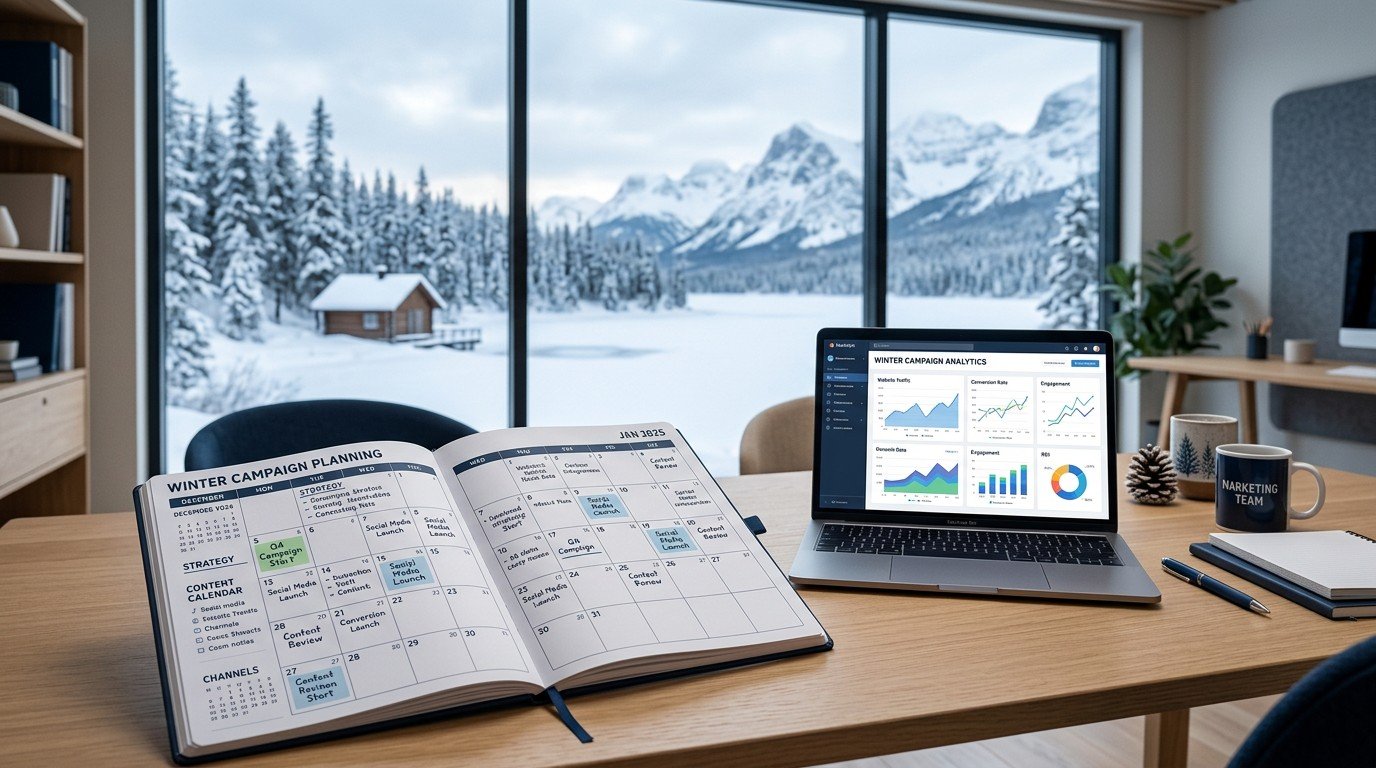
For northern tourism operators and retailers, winter is not just a season — it is the season. A single booking window, a stretch of peak demand, or a well-timed shoulder campaign can determine whether the year ends in the black or the red. Yet most generic marketing calendars are built for temperate markets with predictable demand curves. They do not account for ferry cancellations, road closures, the narrow window between aurora season and ski season, or the reality that your best customers may be booking from a different time zone entirely.
This guide walks you through building a winter marketing campaign calendar for northern businesses that is grounded in your actual demand signals, resilient to disruption, and structured to extract value from every phase of the season — not just the peak.
Start with Transport Links, Booking Behavior, and Demand Indicators
Before you open a spreadsheet or brief a designer, gather the data that shapes your season. For northern businesses, demand is rarely driven by marketing alone — it follows infrastructure.
Map your transport dependencies. Which ferry routes, roads, or flight connections bring your customers to you? When do they typically open, close, or become unreliable? Build these dates into your calendar as hard constraints, not afterthoughts. A campaign that drives bookings for a period when access is uncertain will generate refund requests, not revenue.
Analyze your booking window. Look at two or three years of booking data and identify when customers typically commit. Northern tourism bookings often cluster 8–16 weeks before arrival for peak periods, but shoulder-season bookings may come in much later — sometimes within two weeks. Your campaign timing should match these windows, not a generic “book early” assumption.
Identify your demand indicators. What signals predict a strong season? Snowfall forecasts, aurora activity indices, school holiday calendars in your key source markets, and competitor pricing can all serve as leading indicators. Set up simple monitoring so you can accelerate or pull back spend as conditions develop.
Plan Campaign Phases Around Anticipation, Peak Demand, and Late Availability
A winter campaign calendar is not a single campaign — it is a sequence of phases, each with a different objective and audience.
Phase 1: Anticipation (10–16 weeks before peak). This is your awareness and early-booking phase. Target past guests and warm audiences with content that builds excitement: destination imagery, itinerary ideas, and early-bird offers with genuine scarcity. Email sequences work well here because they allow you to nurture interest over several weeks without the cost of sustained paid media.
Phase 2: Peak demand (4–10 weeks before arrival). Conversion is the priority. Paid search and social retargeting should be running at full budget. Your messaging should emphasize availability, social proof, and the specific experiences that differentiate your offering. This is also the phase where internal linking between your destination pages and booking pages matters most — make sure your site architecture supports the journey.
Phase 3: Late availability (0–4 weeks before arrival). Not every seat or room will fill during peak demand. A late-availability campaign targeting flexible travelers — often younger audiences or those within driving distance — can recover significant revenue. Keep the creative simple and the offer clear. Urgency is real at this stage; you do not need to manufacture it.
For a practical framework on building content that supports each phase, see our guide on how to build a low-bandwidth webinar program for remote audiences — the sequencing principles apply equally to campaign planning.
Design Offers Around Visitor Value Rather Than Volume Alone
The instinct in a slow shoulder season is to discount. Discounting can work, but it trains your audience to wait for lower prices and compresses your margins in the periods when you need them most.
A more durable approach is to build offers around visitor value — the combination of experiences, convenience, and certainty that makes a booking feel worth the full price.
Bundle experiences rather than cutting rates. A guided snowshoe tour, a local dinner, and a transfer from the airport bundled into a package at a modest premium over the room rate alone is more compelling than a 20% discount — and it protects your average booking value.
Offer flexibility as a premium feature. Free cancellation up to 48 hours before arrival, or a date-change guarantee, can be more persuasive than a price reduction for travelers who are uncertain about northern weather or transport. Price this as an add-on or include it in a higher-tier package.
Highlight what is unique to the shoulder season. Fewer crowds, lower prices at local restaurants, better access to guides, and the particular quality of light in early winter or late spring are genuine selling points. Lean into them rather than apologizing for the quieter period.
Research from the World Tourism Organization consistently shows that high-value travelers — those who spend more per trip and return more often — are more responsive to experience-led offers than to price promotions.
Prepare Message Branches for Restrictions and Infrastructure Disruption
Every northern marketer has a story about a campaign that launched the week a key road closed or a ferry route was suspended. Disruption is not an edge case — it is a structural feature of operating in remote regions.
Build message branches into your campaign calendar before the season starts.
Define your trigger conditions. What constitutes a disruption that requires a message change? A road closure affecting more than 20% of your arrivals? A weather event that makes the primary activity unavailable for more than three days? Be specific so your team can act without waiting for a decision.
Prepare holding messages in advance. Draft two or three versions of your key campaign emails and ads that can be activated quickly: one that acknowledges disruption and offers rebooking flexibility, one that pivots to alternative experiences, and one that pauses promotion entirely while conditions are assessed.
Communicate proactively with booked guests. Customers who hear about a disruption from you — before they read about it elsewhere — are far more likely to rebook than to request a refund. A simple automated email triggered by your internal disruption flag can protect a significant share of your revenue.
For more on building resilient customer communication systems, Retention Economics in Sparse Markets covers the lifetime value case for proactive guest communication in northern e-commerce contexts.
Use Local Experiences to Strengthen Shoulder-Season Demand
The shoulder season — the weeks before and after peak winter demand — is where the most creative marketing work happens. It is also where local partnerships make the biggest difference.
Identify what is genuinely available in the shoulder season. Early-season snowfall, late-season ice fishing, local festivals, and the transition between seasons all offer content and experience hooks that peak-season visitors never see. Document these with photography and video before the season ends.
Build partnerships with local operators. A collaboration with a local guide, a restaurant, or a cultural organization can create a shoulder-season package that neither party could offer alone. These partnerships also generate content — joint social posts, shared email lists, and cross-promotion — that extends your reach without additional media spend.
Target your existing guest database. Past guests who visited during peak season are the most likely candidates for a shoulder-season return. A segmented email campaign with a personal tone — “You visited us in February; here is what March looks like” — consistently outperforms broad prospecting for shoulder-season bookings.
Build the Calendar, Then Protect It
A seasonal marketing plan for winter tourism is only useful if it survives contact with the season. Build in a weekly review cadence — 30 minutes to check booking pace against forecast, review any disruption signals, and adjust spend or messaging as needed.
Keep the calendar in a shared format that your whole team can access and update. The goal is not a perfect plan executed without deviation — it is a living document that helps your team make faster, better decisions when conditions change.
At ArcticMarketer, we work with northern businesses to build marketing systems that are as resilient as the landscapes they operate in. If you are planning your winter campaign calendar and want a second opinion on your phasing, offers, or disruption protocols, explore our resources for practical frameworks built for northern markets.
Word count: approximately 1,200 words