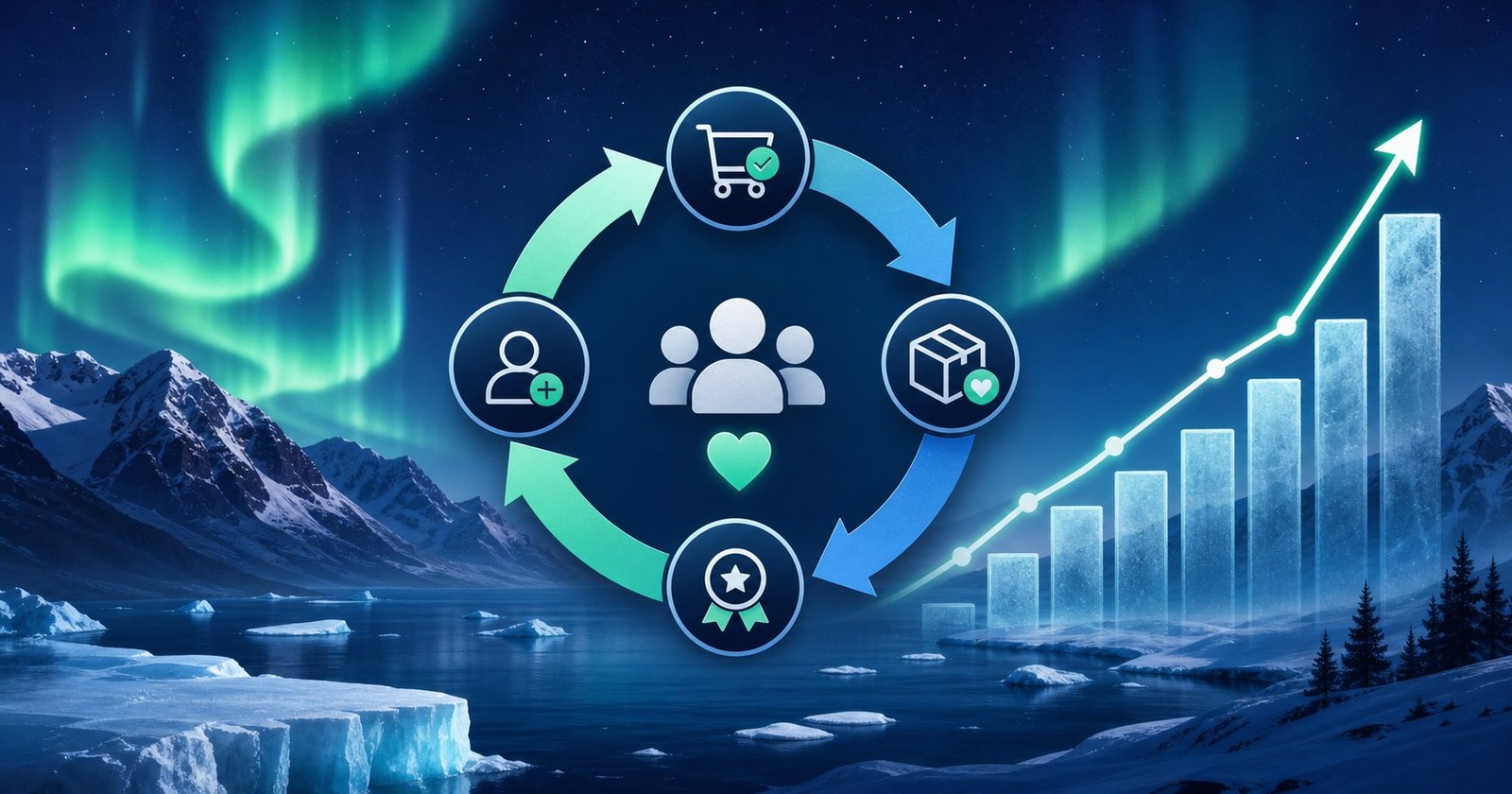
In remote and northern markets, every customer counts — literally. When your nearest competitor is a long drive away and your potential customer base is measured in thousands rather than millions, the economics of customer acquisition versus retention look very different from what mainstream e-commerce playbooks assume.
For northern e-commerce brands, the math is stark: acquiring a new customer costs five to twenty-five times more than retaining an existing one. In sparse markets where population density is low and logistics costs are high, that gap widens even further. Yet most digital marketing advice focuses almost entirely on acquisition — new traffic, new leads, new conversions. This post flips that script.
Here’s what the data says, and what it means for your northern e-commerce strategy.
The True Cost of Acquisition in Sparse Geographies
The average e-commerce brand loses approximately $29 for every newly acquired customer when you factor in advertising spend, platform fees, and fulfillment costs. In northern and remote markets, that figure climbs higher still. Shipping to remote postcodes is expensive. Paid advertising in low-density regions often yields higher cost-per-click with smaller audience pools. And word-of-mouth — the most cost-effective acquisition channel — spreads more slowly when your community is geographically dispersed.
This is why e-commerce customer retention in sparse markets isn’t just a nice-to-have — it’s a survival strategy. Research from Bain & Company consistently shows that a 5% improvement in customer retention can increase overall business profits by 25% to 95%. For a northern brand operating on thin margins with high logistics overhead, that kind of profitability swing is transformational.
The implication is clear: if you’re spending 80% of your marketing budget chasing new customers while neglecting the ones you already have, you’re fighting the wrong battle.
The 5% Retention Effect: What It Means for Northern Brands
Let’s put the 5% retention effect in concrete terms. Imagine a northern e-commerce store with 2,000 active customers and an average order value of $85. If 30% of those customers make a second purchase within 12 months, annual repeat revenue is $51,000. Improve that retention rate by just 5 percentage points — to 35% — and repeat revenue climbs to $59,500. That’s an $8,500 gain without spending a single dollar on new customer acquisition.
Now layer in customer lifetime value (CLV). A customer who buys three times is worth exponentially more than one who buys once, because their acquisition cost is already sunk. Northern brands that build systems to drive second and third purchases are effectively compounding their marketing ROI with every repeat transaction.
The trend is clear: the brands winning in sparse markets aren’t necessarily the ones with the biggest ad budgets. They’re the ones with the highest retention rates.
AI Personalization: The Retention Engine Most Northern Brands Aren’t Using
One of the most significant shifts in e-commerce retention over the past two years is the democratization of AI-driven personalization. What was once the exclusive domain of Amazon and Shopify’s largest merchants is now accessible to small and mid-sized northern brands through affordable SaaS tools.
The numbers are compelling: 92% of businesses that implement AI-driven personalization report measurable increases in customer spending, with average order values rising by 38%. Personalization works because it makes customers feel seen — and in remote communities where generic, one-size-fits-all marketing is the norm, that feeling of recognition is a powerful differentiator.
Practical AI personalization tactics for northern e-commerce brands include:
- Behavioural email triggers — automated messages sent when a customer browses a product category without purchasing, or when a previously purchased item is likely running low
- Dynamic product recommendations — homepage and cart page recommendations tailored to individual browsing and purchase history
- Predictive replenishment — for consumable products, proactively reminding customers to reorder before they run out
- Segmented post-purchase sequences — different follow-up email flows for first-time buyers versus loyal customers
Tools like Klaviyo, Omnisend, and even Shopify’s native analytics make these capabilities accessible without enterprise-level budgets. For more on building automated email sequences that work across time zones, see our guide on Email Automation for Remote Businesses.
Loyalty Programs and Subscription Models: Structural Retention Drivers
Beyond personalization, the most durable retention gains come from structural mechanisms that make staying loyal the path of least resistance. Two stand out for northern e-commerce brands: loyalty programs and subscription models.
Loyalty programs generate an average ROI of 5.2x when implemented well. The key word is “well” — a points system that customers forget about within a week delivers little value. Effective loyalty programs for northern brands share three characteristics:
- Simplicity — customers understand exactly how to earn and redeem rewards without reading a FAQ
- Relevance — rewards align with what northern customers actually value (free shipping to remote addresses, early access to seasonal products, community recognition)
- Momentum — customers feel progress toward a meaningful reward quickly, not after 18 months of purchases
Subscription models take retention a step further by converting one-time buyers into recurring revenue. Subscription customers have significantly higher retention rates than transactional buyers, and they provide the predictable cash flow that helps northern brands manage the seasonal demand swings common in cold-climate markets. If your product is consumable, seasonal, or regularly replenished, a subscription option is worth testing.
Omnichannel Service: The Retention Factor Most Brands Underestimate
Here’s a retention insight that surprises many e-commerce operators: 95% of consumers cite customer service quality as a critical factor in their loyalty decisions. Not price. Not product selection. Service.
In northern markets, where customers often have fewer alternatives and higher switching costs (both logistical and psychological), exceptional service is a genuine competitive moat. Brands that invest in omnichannel service — consistent, responsive support across email, chat, social media, and phone — achieve retention rates up to 89%, compared to just 33% for brands with fragmented service experiences.
For northern e-commerce brands, this means:
- Proactive communication about shipping delays or stock issues before customers have to ask
- Generous return policies that account for the logistical complexity of returning items from remote locations
- Community touchpoints — local events, social media groups, or regional partnerships that make customers feel part of something beyond a transaction
This connects to what researchers call Expectation-Confirmation Theory: customers stay loyal when their post-purchase experience meets or exceeds what they expected. The features that attract buyers (competitive pricing, product range) are often different from the features that retain them (reliable service, proactive problem resolution, genuine community connection).
For northern brands building their digital presence from the ground up, our Affiliate Marketing for Northern Brands guide offers complementary strategies for extending your reach while keeping acquisition costs manageable.
Building Your Retention Stack: A Practical Starting Point
If you’re a northern e-commerce brand ready to shift focus from acquisition to retention, here’s a prioritized starting framework:
- Audit your current repeat purchase rate — if you don’t know this number, find it in your e-commerce analytics dashboard. It’s your baseline.
- Implement post-purchase email automation — a three-email sequence (thank you, product tips, repurchase prompt) is the highest-ROI retention investment most brands can make in under a week.
- Add a simple loyalty mechanism — even a basic points-for-purchases system signals to customers that you value their ongoing relationship.
- Identify your top 20% of customers — these are your highest-CLV buyers. What do they have in common? What keeps them coming back? Build your retention strategy around replicating that experience.
- Measure and iterate — track repeat purchase rate, CLV, and churn rate monthly. Retention improvements compound over time, but only if you’re measuring them.
The northern e-commerce brands that will thrive in the next five years won’t necessarily be the ones with the biggest marketing budgets. They’ll be the ones that understand the unique economics of sparse markets — and build retention systems that turn every hard-won customer into a long-term relationship.
Ready to build a retention-first marketing strategy for your northern brand? Explore more practical guides at ArcticMarketer.com and start turning your existing customers into your most powerful growth engine.
Sources: Bain & Company retention research; Shopify e-commerce benchmarks 2026; LinkedIn B2B Institute thought leadership data; Klaviyo email marketing benchmarks.