If you run a northern business—a remote lodge, a cold-climate outfitter, a seasonal retailer, or a rural trades operation—you’ve probably heard conflicting advice about YouTube. Post short clips. No, post long guides. Go vertical. No, stay horizontal. The debate misses the point: the best YouTube content strategy for cold climate businesses isn’t about picking one format and sticking to it. It’s about understanding what each format does for your audience and building a system that uses both.
In 2026, YouTube has become the second-largest search engine on the planet, and for businesses in northern and cold-climate markets, that matters more than ever. Your customers are searching for answers to questions that most mainstream content creators never address: How do you winterize a remote cabin? What gear do you actually need for a northern fishing trip? How does a small-town retailer handle shipping delays in January? You have the expertise. The question is how to package it.
Why Short and Long Videos Serve Different Customer Needs
Short videos—under three minutes—serve a fundamentally different purpose than long-form guides. Short clips are discovery tools. They answer one specific question, demonstrate one technique, or capture one moment that makes a viewer stop scrolling. For northern businesses, this might be a 90-second clip showing how to pack a cold-weather emergency kit, a quick tour of a remote accommodation, or a time-lapse of a seasonal setup.
Long-form videos—ten minutes or more—build authority and trust. They’re what a potential customer watches when they’re seriously considering a purchase, a booking, or a partnership. A 15-minute guide to planning a first winter wilderness trip, a detailed walkthrough of your production process, or an honest conversation about what remote living actually looks like: these are the videos that convert browsers into buyers.
The mistake most small businesses make is treating these as competing formats. They’re not. They’re different rungs on the same ladder.
Turn One Northern Question Into a Three-Level Format Ladder
Think of your YouTube content as a three-level system. At the top, short discovery clips (under 3 minutes) answer the specific questions your customers type into search. These are your entry points—optimized for YouTube search, Shorts, and social sharing. Use keyword-rich titles, clear spoken answers in the first 30 seconds, and on-screen text that reinforces your main point.
In the middle, medium-length explainers (3–8 minutes) go deeper on topics your short clips introduce. If a 90-second clip answers “What is a parcel locker?”, a 5-minute explainer covers “How northern retailers can use parcel lockers to reduce failed deliveries.” These videos work well for viewers who found you through a short clip and want more.
At the base, long-form guides (10+ minutes) establish your expertise on topics that matter most to your best customers. These are the videos that rank for competitive search terms, earn backlinks, and get shared in community groups. For a cold-climate business, this might be a comprehensive seasonal preparation guide, an in-depth interview with a local expert, or a detailed case study of how you solved a problem your customers face.
For more on building content systems that work across formats, see our guide on content repurposing for northern small businesses.
Use Short Videos for Discovery and Deep Guides for Trust
Here’s a practical workflow: start with your most common customer questions. Write them down exactly as customers ask them—not as you’d phrase them internally. Each question is a potential short video. Group related questions into themes. Each theme is a potential explainer. The themes that come up most often, or that represent your highest-value customers, become your long-form guides.
For a northern tourism operator, this might look like:
– Short clips: “What’s the weather like in [region] in February?” / “Do I need a guide for [activity]?” / “What’s included in a [package] booking?”
– Explainers: “Planning your first winter trip to [region]” / “What to expect from a guided [activity] experience”
– Long-form guides: “The complete northern adventure planning guide” / “A year in the life of a remote lodge operator”
The key is that each level feeds the next. A viewer who watches your short clip and wants more finds your explainer. A viewer who watches your explainer and is seriously interested finds your long-form guide. By the time they reach out, they already trust you.
Create Repeatable Series Around Conditions, Skills, and Place
Northern and cold-climate businesses have a natural advantage on YouTube: you operate in environments and conditions that most of your audience has never experienced. That’s inherently interesting. Use it.
Build repeatable series around the conditions, skills, and places that define your work. A cold-climate retailer might run a “Winter Ready” series covering seasonal preparation topics. A remote lodge might document the shoulder season—the weeks between peak periods when the real work happens. A northern trades business might create a “How We Do It Up Here” series showing how standard techniques adapt to extreme conditions.
Repeatable series do two things: they give viewers a reason to subscribe (they know more is coming), and they make your production process more efficient (you’re not reinventing the format every time). According to YouTube’s Creator Academy, channels with consistent series formats tend to see stronger subscriber retention than channels that post one-off videos without a connecting theme.
For seasonal businesses, consider how your series can reflect the rhythm of your year. A summer-focused outdoor business might run a “Season Prep” series in spring, a “In the Field” series during peak season, and a “What We Learned” series in autumn. This keeps your channel active year-round and gives returning customers a reason to keep watching.
Evaluate Watch Behavior, Enquiries, and Qualified Leads
Most small businesses measure YouTube success by subscriber count or total views. These numbers feel good but often don’t connect to business outcomes. For a northern business with a specific customer base, a video that reaches 200 highly qualified viewers is worth more than one that reaches 20,000 people who will never book a trip or place an order.
Focus on metrics that connect to your actual business goals:
– Watch time and average view duration: Are viewers staying long enough to hear your key messages?
– Click-through rate on end screens and cards: Are viewers moving from one video to the next?
– Traffic sources: Are your videos appearing in YouTube search for the terms you’re targeting?
– Enquiries and bookings that reference YouTube: Ask new customers how they found you.
For seasonal businesses, track how your YouTube traffic patterns align with your booking or sales cycles. If your long-form guides drive enquiries in the weeks before your peak season, that’s a signal to publish them earlier next year. For more on connecting content performance to business outcomes, see our post on analytics trends for northern and seasonal businesses.
Building Your YouTube Strategy Without Burning Out
The biggest barrier for small northern businesses isn’t knowing what to make—it’s finding the time to make it consistently. A few principles help:
Batch your production. If you’re already filming a project, capture short clips at the same time. One day of filming can produce a long-form guide, two or three explainers, and a handful of short clips.
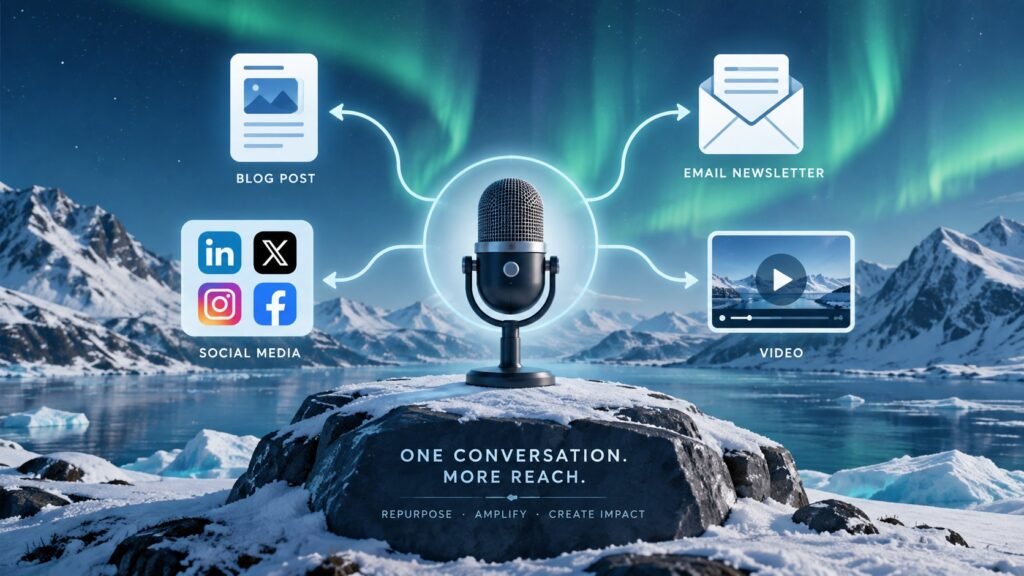
Repurpose before you recreate. A long-form guide can be cut into multiple short clips. A series of short clips can be compiled into an explainer. You don’t need to start from scratch every time.
Publish on a schedule you can sustain. One video per week, consistently, outperforms three videos one month and nothing the next. YouTube’s algorithm rewards consistency, and so do subscribers.
Use your environment as your studio. You don’t need professional equipment to make useful videos. A smartphone, decent audio, and good natural light are enough to start. The northern landscape, the seasonal conditions, and the real work you do every day are more compelling than any studio backdrop.
YouTube in 2026 rewards businesses that show up consistently, answer real questions, and build genuine expertise over time. For cold-climate and northern businesses, the content is already there—in the conditions you navigate, the knowledge you’ve built, and the questions your customers keep asking. The format ladder just gives you a way to organize it.
ArcticMarketer helps northern and cold-climate businesses build digital marketing strategies that fit their markets, their seasons, and their customers. Explore our content marketing resources for more practical guides.