If you run marketing for a northern or rural business, you already know the constraint: a small team, a packed seasonal calendar, and an audience that can tell immediately when content feels generic or out of place. AI writing and workflow tools have matured enough in 2026 that they genuinely reduce the time spent on repeatable tasks — but the businesses getting the most value are not the ones handing everything to a chatbot. They are the ones using AI to handle the scaffolding while keeping local knowledge firmly in human hands.
This post looks at where AI content workflows are actually delivering results for small northern marketing teams, where the risks are real, and how to build a process that saves time without eroding the credibility you have spent years building.
Start With Bottlenecks, Not a List of AI Tools
The most common mistake small teams make when adopting AI is starting with the tool rather than the problem. Before you sign up for another platform, spend thirty minutes mapping where your content process actually stalls.
For most northern businesses, the bottlenecks cluster in a few predictable places:
- First drafts. Staring at a blank page after a long field day or a busy season is exhausting. AI can turn rough notes into a structured first draft in minutes.
- Channel adaptation. Writing the same core message for email, social, and a product page takes time. AI handles format switching well when given a strong source document.
- Routine descriptions. Product listings, event summaries, and FAQ updates are repetitive. These are low-risk tasks where AI saves real hours.
- Content inventory. Auditing what you have published, identifying gaps, and tagging old posts for repurposing is tedious work that AI tools can accelerate significantly.
Identify your top two bottlenecks before choosing any tool. That focus will save you from building a complicated workflow around a problem you do not actually have.
Four Low-Risk Marketing Tasks AI Can Accelerate
Not every marketing task is equally suited to AI assistance. These four areas consistently deliver time savings for small northern teams without introducing significant quality risk.
1. Turning field notes into first drafts
If your team captures notes during a product test, a guided trip, or a seasonal event, AI can transform those raw notes into a structured blog post or email draft. The key is giving the AI enough specific detail — dates, locations, conditions, customer reactions — so the output reflects your actual experience rather than a generic version of it.
2. Repurposing long-form content into shorter formats
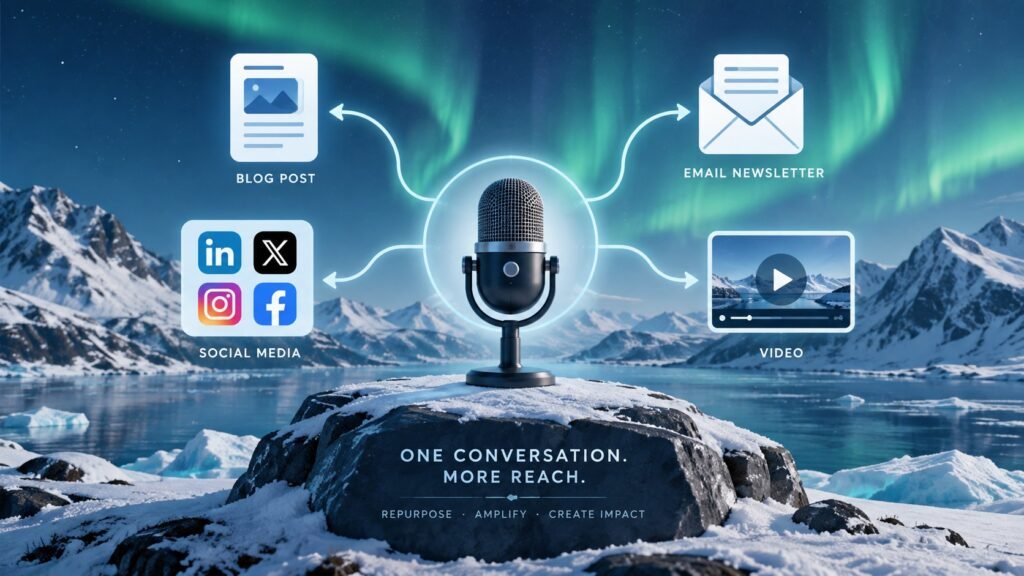
A 1,000-word blog post contains enough material for three social captions, one email intro, and a product page update. AI tools can extract and reformat this content quickly. You review and adjust for tone; the AI handles the mechanical work of condensing and restructuring.
3. Generating meta descriptions and title variations
SEO metadata is important but time-consuming to write well. AI can produce five or six variations of a meta description or page title in seconds, giving your team options to evaluate rather than a blank field to fill.
4. Drafting FAQ responses from customer questions
If your inbox or social comments contain recurring questions, AI can draft answers from your existing content. This is particularly useful for northern businesses with complex logistics — shipping timelines, seasonal availability, access conditions — where customers ask the same questions repeatedly.
Build Source Material That Gives AI Useful Local Context
The quality of AI output is directly proportional to the quality of the input you provide. Generic prompts produce generic content. Specific, locally grounded prompts produce drafts that actually sound like your business.
Before you start a content session, build a brief context document that includes:
- Your business name, location, and the specific region or community you serve
- The season or time of year and what that means for your customers
- Two or three things your audience cares about that a generic AI would not know
- Any terminology, place names, or cultural references that matter to your audience
- The tone you use — formal, conversational, technical, warm
Paste this context at the start of every AI session. It takes two minutes and dramatically improves the relevance of what comes back. For teams doing regular content work, save this as a reusable prompt template.
For more on building content that resonates with northern audiences, see our guide on content repurposing strategies for small teams and how voice search optimization can extend your reach in remote markets.
Create a Human-Review Checklist for Facts, Tone, and Cultural Fit
AI makes confident-sounding mistakes. For northern businesses, the consequences of a factual error — a wrong shipping zone, an inaccurate seasonal date, a misrepresented local condition — can damage trust with an audience that has limited alternatives and long memories.
Build a short review checklist that every AI-assisted piece goes through before publication:
Facts and specifics
– Are all dates, prices, and availability windows accurate?
– Are location names and regional references correct?
– Does the content reflect current conditions, not last season’s?
Tone and voice
– Does this sound like us, or does it sound like a press release?
– Have we removed any phrases that feel corporate or out of place for our audience?
– Is the level of formality right for this channel?
Cultural and community fit
– Does this content respect the community context we operate in?
– Have we avoided generalizations about northern or rural life that our audience would find inaccurate?
– Would a long-time local customer recognize this as coming from us?
This checklist does not need to take long — ten minutes of focused review catches most problems. The goal is not to rewrite the AI’s work from scratch but to verify the specifics and adjust the voice.
Measure Time Saved and Content Quality After a 30-Day Pilot
Before committing to a full AI content workflow, run a structured 30-day pilot on one content type — blog posts, email newsletters, or social captions. Track two things: time spent per piece and audience response (open rates, engagement, comments).
Most northern marketing teams find that AI assistance cuts first-draft time by 40 to 60 percent on routine content. The more important finding is usually qualitative: after a few weeks of working with AI-assisted drafts, teams develop a clearer sense of which tasks benefit from AI and which ones — local storytelling, community announcements, sensitive customer communications — are better done entirely by hand.
The businesses seeing the strongest results in 2026 are treating AI as a capable junior assistant: useful for structure and speed, but always supervised by someone who knows the community, the season, and the customer.
AI content workflows are not a shortcut to replacing the local knowledge that makes northern marketing credible. They are a way to spend less time on the mechanical parts of content production so your team has more capacity for the work that actually requires human judgment. Start with your real bottlenecks, build strong source material, review everything before it goes out, and measure what changes. That is a workflow worth keeping.
For more practical marketing guidance built for northern and remote businesses, explore the resources at ArcticMarketer.